INFORMATION TECHNOLOGY
About the Department
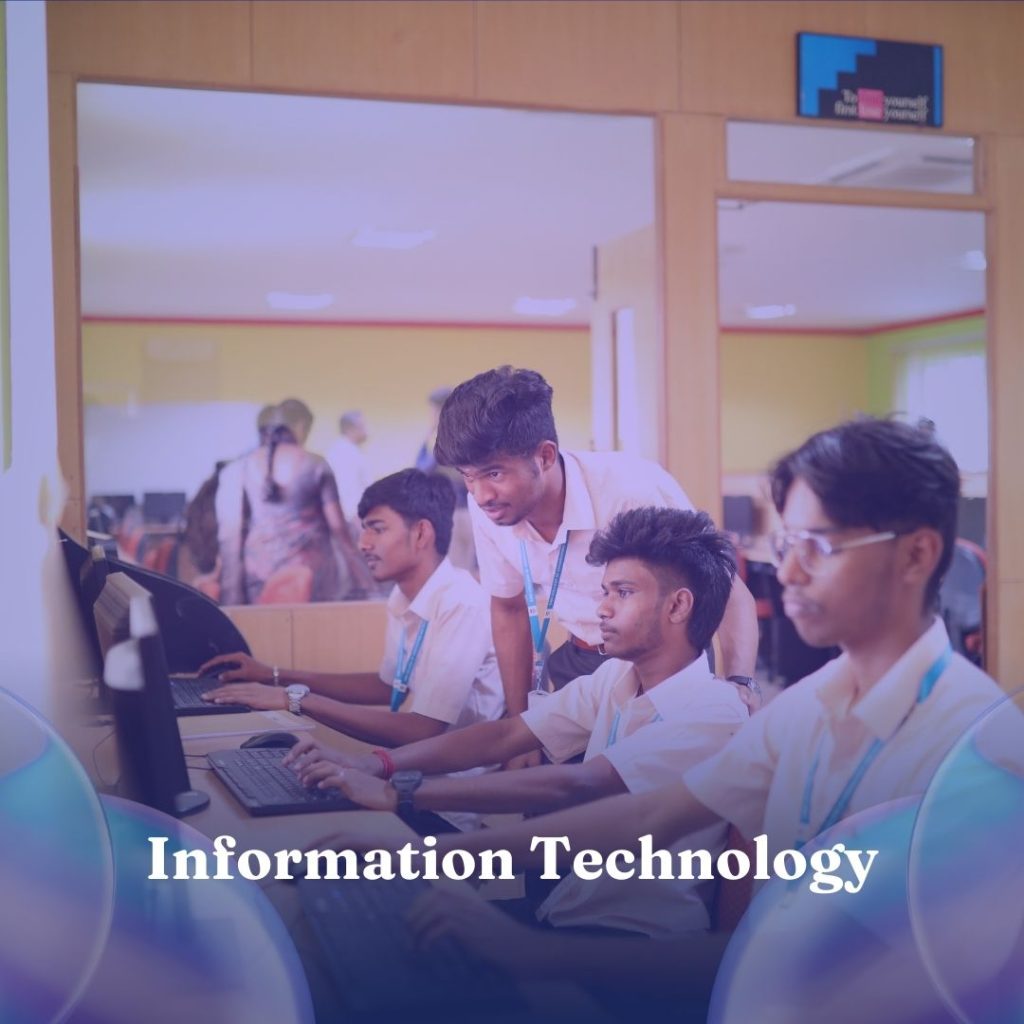
The Department of Information Technology was established in the year 2023 to address the growing need of engineering talent with skills in Digital Technology, has designed a curriculum for 4 years undergraduate program. This curriculum aims to ensure that the students graduating from the program not only know the core topics of Computer Science but also develop an equal appreciation of Humanities, Management Sciences, and Human Values. The students are also exposed to emerging topics such as Analytics, Machine Learning, Cloud Computing, the Internet of Things, etc., to make them industry ready at the end of four years of study. The students are also exposed to pursue Higher Studies in Reputed Universities Abroad and India with varied specializations and to become a successful Entrepreneur in the IT domain with Innovative Business Skills acquired through the competent curriculum.
Courses
Vision
Mission
- M1: To form a strong foundation in computing, networking, software development, and information systems aligned with emerging technologies.
- M2: To establish healthy industry-academia collaboration for skill enhancement, internships, and career readiness.
- M3: To raise innovation, problem-solving, and entrepreneurship skills through research, project-based learning that addresses real-world IT challenges.
- M4: To emphasize effective compliance with professional ethics and corporate social responsibilities for personal, organizational and social sustainable development.
Program Educational Objectives (PEOs)
Graduates of the IT program will:
- PEO1: Apply IT knowledge and modern digital tools to solve real-world problems across industries and communities.
- PEO2: Demonstrate leadership, Communication, collaboration, and ethical behavior in multidisciplinary and global work environments.
- PEO3: Pursue advanced studies through higher education, certifications to remain updated with evolving technologies, and lifelong learning.
- PEO4: Innovate and contribute to sustainable digital IT solutions that support economic and social development.
Program Outcomes (POs)
Graduate Attribute
- Engineering knowledge: Apply the knowledge of mathematics, science, engineering fundamentals, and an engineering specialization to the solution of complex engineering problems.
- Problem analysis: Identify, formulate, review research literature, and analyze complex engineering problems reaching substantiated conclusions using first principles of mathematics, natural sciences, and engineering sciences.
- Design/development of solutions: Design solutions for complex engineering problems and design system components or processes that meet the specified needs with appropriate consideration for the public health and safety, and the cultural, societal, and environmental considerations.
- Conduct investigations of complex problems: Use research-based knowledge and research methods including design of experiments, analysis and interpretation of data, and synthesis of the information to provide valid conclusions.
- Modern tool usage: Create, select, and apply appropriate techniques, resources, and modern engineering and IT tools including prediction and modeling to complex engineering activities with an understanding of the limitations.
- The engineer and society: Apply reasoning informed by the contextual knowledge to assess societal, health, safety, legal and cultural issues and the consequent responsibilities relevant to the professional engineering practice.
- Environment and sustainability: Understand the impact of the professional engineering solutions in societal and environmental contexts, and demonstrate the knowledge of, and need for sustainable development.
- Ethics: Apply ethical principles and commit to professional ethics and responsibilities and norms of the engineering practice.
- Individual and team work: Function effectively as an individual, and as a member or leader in diverse teams, and in multidisciplinary settings.
- Communication: Communicate effectively on complex engineering activities with the engineering community and with society at large, such as, being able to comprehend and write effective reports and design documentation, make effective presentations, and give and receive clear instructions.
- Project management and finance: Demonstrate knowledge and understanding of the engineering and management principles and apply these to one’s own work, as a member and leader in a team, to manage projects and in multidisciplinary environments.
- Life-long learning: Recognize the need for, and have the preparation and ability to engage in independent and life-long learning in the broadest context of technological change.
Program Specific Outcomes(PSOs)
By the end of the program, Graduates will be able to:
- PSO1: Design, develop, and maintain robust software systems using modern programming languages, tools, and methodologies.
- PSO2: Implement secure and scalable IT solutions using web, networking, cloud computing, and database technologies.
- PSO3: Integrate analytics, automation, and decision-support systems to optimize business processes and support strategic decision-making.