COUNSELLING CODE
2772
☎ ADMISSIONS HOTLINE

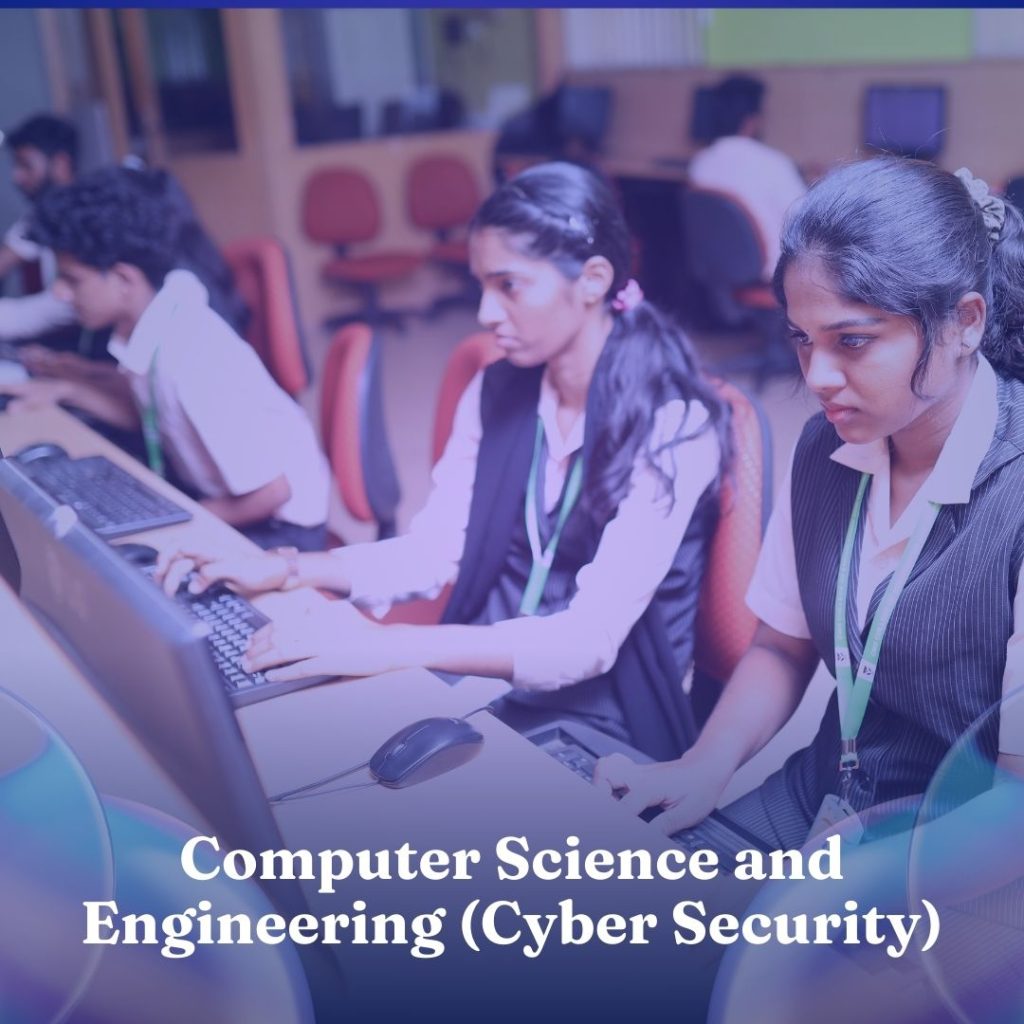
COMPUTER SCIENCE AND ENGINEERING (CYBER SECURITY)

About The Department

The Department of Computer Science and Engineering has been continuously making progress in teaching and R & D activities. Post Graduate programme M.E. – Computer Science and Engineering was introduced in the year 2014.

To achieve excellence not only in teaching-learning processes but also in adopting innovative techniques required to improve product quality in Electronics and Telecom Industries.

The students of the Department have brought out quite number of innovative projects such as GPS in Traffic Management, Smart Cards, etc. The software team of the Department has made laudable contribution by developing software for campus management, attendance help line and on-line test. Many of the students are well placed in leading software companies such as TCS, CTS, Infosys, IBM, Polaris etc.

Courses

Under Graduate : B.E. – Computer Science and Engineering(Cyber Security)

Vision

To stimulate a centre of excellence in cybersecurity exploration and research by emerging virtuously responsible professionals with resilient technical expertise in safeguarding a secure digital society.

Mission

  • M1: To deliver in-depth technical knowledge and pro-active experience in cybersecurity, ethical hacking, and digital forensics.
  • M2: To improve innovation, critical thinking, and research competencies in the domain of cyber defence and secure computing.
  • M3: To enrich industry inclination through practical exposure, global certifications, and real-time project experience.
  • M4: To nurture socially responsible professionals committed to upholding digital trust, legal compliance, and national security.
Program Educational Objectives (PEOs)

Graduates can

  • PEO1: Apply cybersecurity principles and technologies to solve complex, real-world problems across diverse domains.

  • PEO2: Exhibit leadership, collaboration, and ethical conduct in multidisciplinary professional environments.

  • PEO3: Embrace lifelong learning through certifications, higher education, and awareness of emerging technologies.

  • PEO4: Innovate and contribute to secure, sustainable, and inclusive digital transformation through entrepreneurship and social responsibility.

Program Outcomes (POs)

  • Graduate Attribute
  • Engineering knowledge: Apply the knowledge of mathematics, science, engineering fundamentals, and an engineering specialization to the solution of complex engineering problems.
  •  Problem analysis: Identify, formulate, review research literature, and analyze complex engineering problems reaching substantiated conclusions using first principles of mathematics, natural sciences, and engineering sciences.
  • Design/development of solutions: Design solutions for complex engineering problems and design system components or processes that meet the specified needs with appropriate consideration for the public health and safety, and the cultural, societal, and environmental considerations.
  • Conduct investigations of complex problems: Use research-based knowledge and research methods including design of experiments, analysis and interpretation of data, and synthesis of the information to provide valid conclusions.
  • Modern tool usage: Create, select, and apply appropriate techniques, resources, and modern engineering and IT tools including prediction and modeling to complex engineering activities with an understanding of the limitations.
  • The engineer and society: Apply reasoning informed by the contextual knowledge to assess societal, health, safety, legal and cultural issues and the consequent responsibilities relevant to the professional engineering practice.
  •  Environment and sustainability: Understand the impact of the professional engineering solutions in societal and environmental contexts, and demonstrate the knowledge of, and need for sustainable development.
  • Ethics: Apply ethical principles and commit to professional ethics and responsibilities and norms of the engineering practice.
  •  Individual and team work: Function effectively as an individual, and as a member or leader in diverse teams, and in multidisciplinary settings.
  •  Communication: Communicate effectively on complex engineering activities with the engineering community and with society at large, such as, being able to comprehend and write effective reports and design documentation, make effective presentations, and give and receive clear instructions.
  • Project management and finance: Demonstrate knowledge and understanding of the engineering and management principles and apply these to one’s own work, as a member and leader in a team, to manage projects and in multidisciplinary environments.
  • Life-long learning: Recognize the need for, and have the preparation and ability to engage in independent and life-long learning in the broadest context of technological change.

Program Specific Outcomes(PSOs)

By the end of the program, Graduates will be able to:

  • PSO1: Design, analyse and implement secure IT systems using cryptographic techniques, network security protocols, and risk assessment frameworks.
  • PSO2: Detect vulnerabilities, investigate, and respond to cybersecurity incidents using penetration testing, digital forensics, and threat intelligence tools.
  • PSO3: Apply legal, ethical, and compliance standards to safeguard information systems in enterprise and government sectors. a

Related Courses

Department Gallery

Scroll to Top