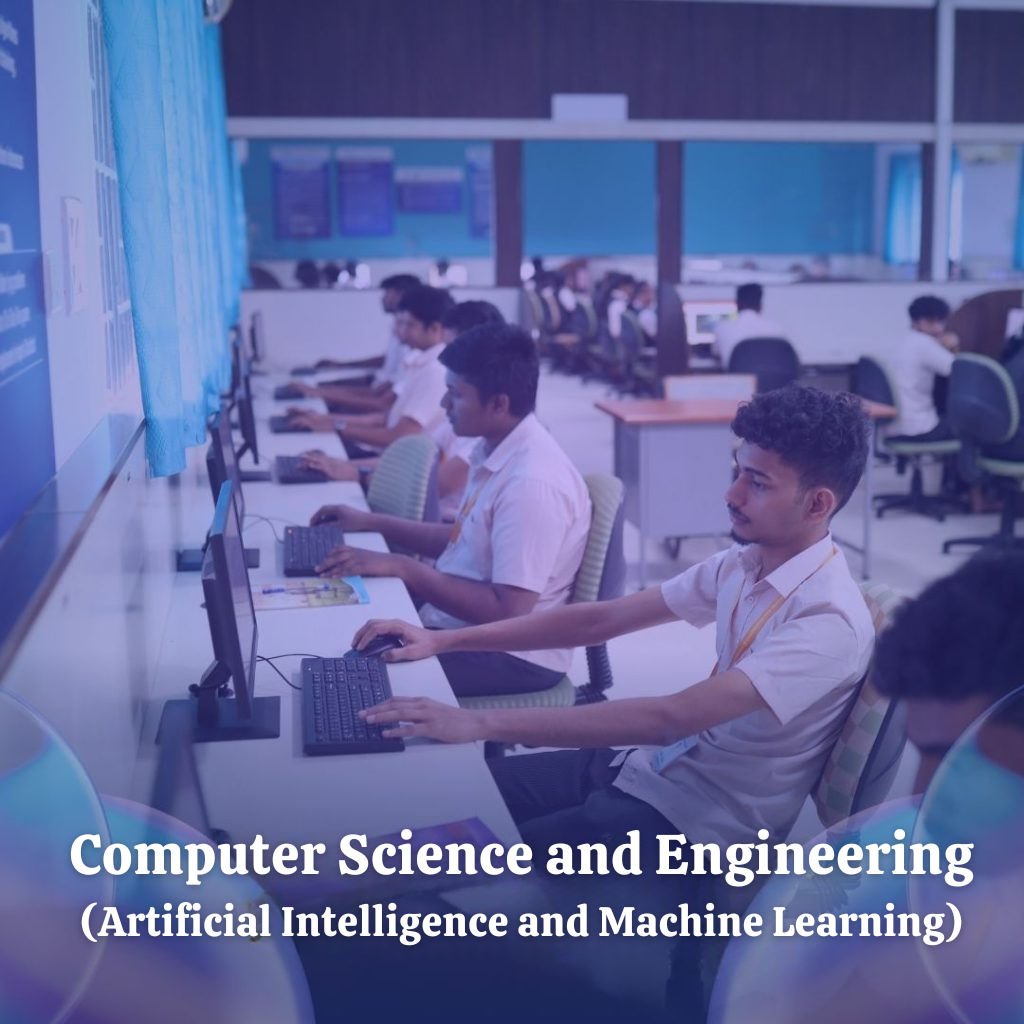
Computer Science and Engineering (AI & ML)
About The Department
The Department of Computer Science and Engineering has been continuously making progress in teaching and R & D activities. Post Graduate programme M.E. – Computer Science and Engineering was introduced in the year 2014.
To achieve excellence not only in teaching-learning processes but also in adopting innovative techniques required to improve product quality in Electronics and Telecom Industries.
The students of the Department have brought out quite number of innovative projects such as GPS in Traffic Management, Smart Cards, etc. The software team of the Department has made laudable contribution by developing software for campus management, attendance help line and on-line test. Many of the students are well placed in leading software companies such as TCS, CTS, Infosys, IBM, Polaris etc.
Courses
Under Graduate : B.E. – Computer Science and Engineering(AI & ML)
Vision
Mission
- M1: To provide a cutting-edge, transdisciplinary education through an agile curriculum that integrates foundational theory with emerging trends in Generative AI, Edge Computing, and Data Science.
- M2: To cultivate a high-impact research ecosystem that fosters collaborative inquiry with global industries and research bodies to solve high-stakes societal and technological challenges.
- M3: To nurture socially conscious technocrats who prioritize integrity, equity, and transparency in the development and deployment of intelligent systems.
- M4: To bridge the gap between academia and industry through immersive experiential learning, entrepreneurship support, and a culture of lifelong curiosity.
Program Educational Objectives (PEOs)
- PEO1: Demonstrate profound expertise in designing and engineering autonomous systems and predictive models to solve multifaceted industrial and global problems.
- PEO2: Excel in diverse roles such as lead engineers, researchers, or entrepreneurs by adapting to the rapidly evolving technological landscape through continuous learning and strategic thinking.
- PEO3: Architect AI solutions that are inclusive, fair, and secure, demonstrating a commitment to professional ethics and the socio-economic advancement of the global community.
Program Outcomes (POs)
Graduate Attribute
- PO1: Engineering Knowledge: Apply math, science, and engineering fundamentals to complex problems.
- PO2: Problem Analysis: Identify and analyze complex problems using research and sustainability principles
- PO3: Design Solutions: Design systems and processes considering health, safety, cost, culture, and environment.
- PO4: Investigations: Use experiments, modelling, and data analysis to reach valid conclusions.
- PO5: Engineering Tools: Apply modern tools for modelling and problem-solving, recognizing their limits
- PO6: Society & Environment: Assess societal, legal, and environmental impacts of engineering solutions
- PO7: Ethics: Commit to ethics, human values, diversity, and legal compliance.
- PO8: Teamwork: Work effectively as an individual and in multidisciplinary teams.
- PO9: Communication: Communicate clearly in reports, presentations, and documentation across diverse groups
- PO10: Management & Finance: Apply management and economic principles in projects and teamwork.
- PO11: Lifelong Learning: Engage in continuous learning, adapt to new technologies, and think critically.
Program Specific Outcomes(PSOs)
- PSO 1: Architect, implement, and optimize end-to-end intelligent systems using advanced machine learning, deep learning, and natural language processing techniques across diverse data domains.
- PSO 2: Leverage state-of-the-art frameworks (such as PyTorch, TensorFlow, and HuggingFace), cloud-native AI services, and distributed computing to build scalable and efficient production-grade applications
- PSO 3: Critically evaluate and mitigate biases, ensure data privacy, and implement explainable AI (XAI) frameworks to ensure the safety and reliability of intelligent deployments in sensitive sectors