COUNSELLING CODE
2772
☎ ADMISSIONS HOTLINE

Mechanical Department

About the Department

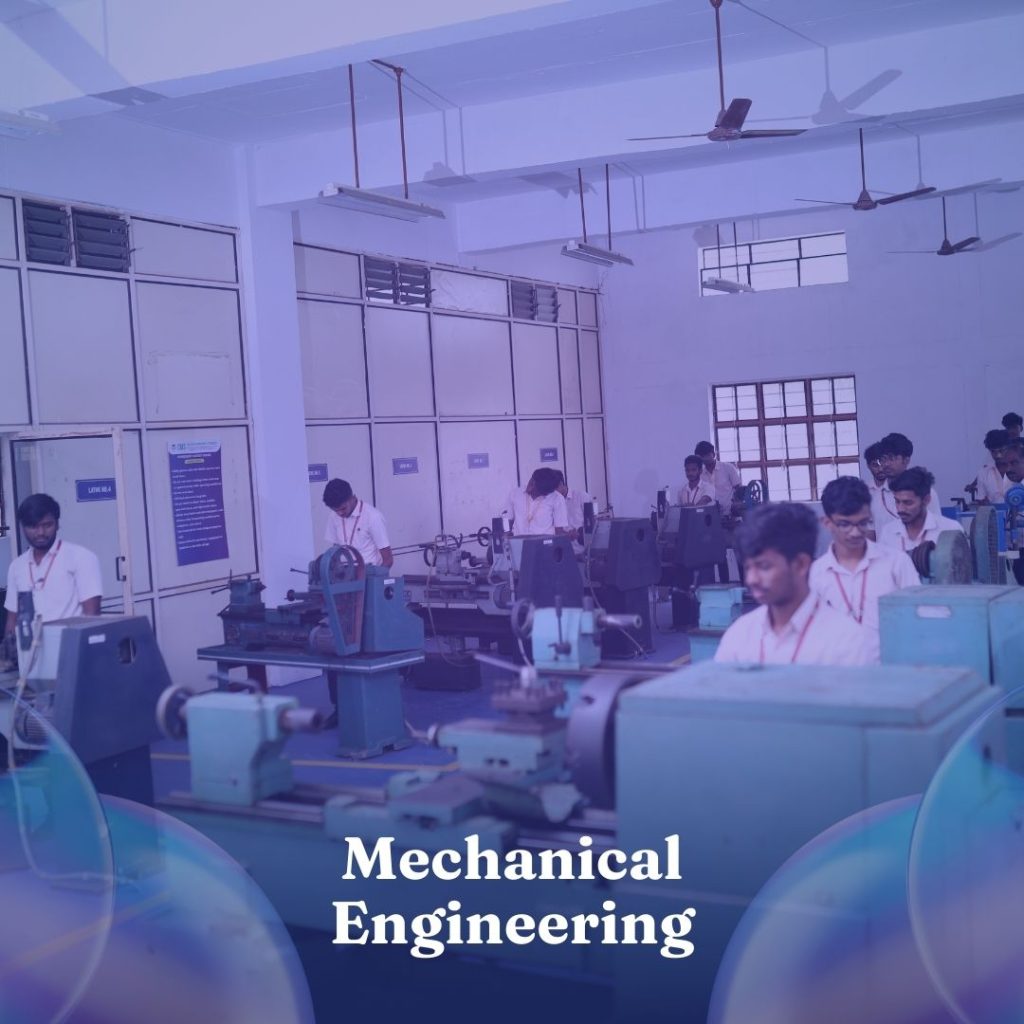
The Department of Mechanical Engineering was established in the year 2010 with the objective of imparting quality education in the field of mechanical engineering.

The department is equipped with amenities, so as to produce worthy future engineers to serve the society and nation at large.

It provides an ideal environment for learning, research and consultancy in the field of mechanical engineering and to produce competent engineers. Smart Class Rooms are provided for the teaching learnging process,through the displiners are enriched level of knowledge in the Mechanical Engineering field all so they have potentailized to improve their interactions ability with the fielders.

Students acquire practical experience by undertaking plant training from industries nearby, by attending industrial visits like thermal power plant, Aviation Industries, Manufacturing Industries etc., with a view to supplement their theoretical knowledge. The department strives to achieve cutting edge in communication, technology inputs to keep pace with the latest trends in mechanical engineering.

The resource persons are being invited at frequent intervals to organize guest lectures, Seminars and workshops for the development of skills of the students. Counseling of students and parent-teachers meetings are conducted in order to improve their students performance in the end semester examinations. Large number of recruiters have shown interest in visiting our institution for their employment needs.Conducted Campus interviews for the selection of the students for their reputed industries.

Courses

Under Graduate : B.E. -Mechanical Engineering

Faculty

The department has an experienced and committed faculty members. They specialize with CAD/CAM, Engineering Design,Industrial Engineering, Manufacturing and Thermal Engineering. The faculty members contribute to the academic development by publishing books and presenting papers in National and International conferences.

Vision

To nurture competent, innovative, environmentally conscious, and self-motivated mechanical engineers with strong ethical values and a commitment to lifelong learning.

Mission

  • M1: To impart quality engineering education with strong fundamentals and emerging technologies to develop competent mechanical engineers.
  • M2: Foster experiential learning, industry collaboration, innovation, and entrepreneurship to enhance employability and professional excellence.
  • M3: To Promote research, sustainable engineering, and interdisciplinary solutions to address industrial and societal challenges.
  • M4: To inculcate ethical values, leadership qualities, teamwork, and a commitment to lifelong learning, enabling students to become globally competent and socially responsible engineering professionals.
PROGRAM EDUCATIONAL OBJECTIVES (PEOs)

  • PEO 1: Graduates will build successful careers in mechanical and allied engineering by applying engineering knowledge and problem-solving skills to address industrial and societal challenges.
  • PEO 2: Graduates will demonstrate professionalism, ethical values, effective communication, and a commitment to lifelong learning while working with industry, academia, and society.
  • PEO 3: Graduates will contribute to research, innovation, and entrepreneurship by developing
    advanced engineering solutions for emerging technological challenges.
  • PEO 4: Graduates will apply teamwork and interdisciplinary knowledge to design and implement sustainable solutions for engineering and environmental challenges.
  • PEO 5: Graduates will exhibit leadership, professional excellence and social responsibility, making meaningful contributions to industry, academia, entrepreneurship and society.

PROGRAM OUTCOMES (POs)

Graduate Attribute

  • Engineering knowledge: Apply the knowledge of mathematics, science, engineering fundamentals, and an engineering specialization to the solution of complex engineering problems.
  • Problem analysis: Identify, formulate, review research literature, and analyse complex engineering problems reaching substantiated conclusions using first principles of mathematics, natural sciences, and engineering sciences.
  • Design/development of solutions: Design solutions for complex engineering problems and design system components or processes that meet the specified needs with appropriate consideration for the public health and safety, and the cultural, societal, and environmental considerations.
  • Conduct investigations of complex problems: Use research-based knowledge and research methods including design of experiments, analysis and interpretation of data, and synthesis of the information to provide valid conclusions.
  • Modern tool usage: Create, select, and apply appropriate techniques, resources, and modern engineering and IT tools including prediction and modelling to complex engineering activities with an understanding of the limitations.
  • The engineer and society: Apply reasoning informed by the contextual knowledge to assess societal, health, safety, legal and cultural issues and the consequent responsibilities relevant to the professional engineering practice.
  • Environment and sustainability: Understand the impact of the professional engineering solutions in societal and environmental contexts, and demonstrate the knowledge of, and need for sustainable development.
  • Ethics: Apply ethical principles and commit to professional ethics and responsibilities and norms of the engineering practice.
  • Individual and team work: Function effectively as an individual, and as a member or leader in diverse teams, and in multidisciplinary settings.
  • Communication: Communicate effectively on complex engineering activities with the engineering community and with society at large, such as, being able to comprehend and write effective reports and design documentation, make effective presentations, and give and receive clear instructions.
  • Project management and finance: Demonstrate knowledge and understanding of the engineering and management principles and apply these to one’s own work, as a member and leader in a team, to manage projects and in multidisciplinary environments.
  • Life-long learning: Recognize the need for, and have the preparation and ability to engage in independent and life-long learning in the broadest context of technological change.

PROGRAM SPECIFIC OUTCOMES (PSOs)

On successful completion of the Mechanical Engineering Degree programme, the Graduates
shall exhibit the following:

  • Apply the knowledge gained in Mechanical Engineering for design and development and manufacture of engineering systems.
  • Apply the knowledge acquired to investigate research-oriented problems in mechanical engineering with due consideration for environmental and social impacts.
  • Use the engineering analysis and data management tools for effective management of multidisciplinary projects.

Related Courses

Scroll to Top